
The Logic of the Hedge: The Success Story of Finca Montserrat
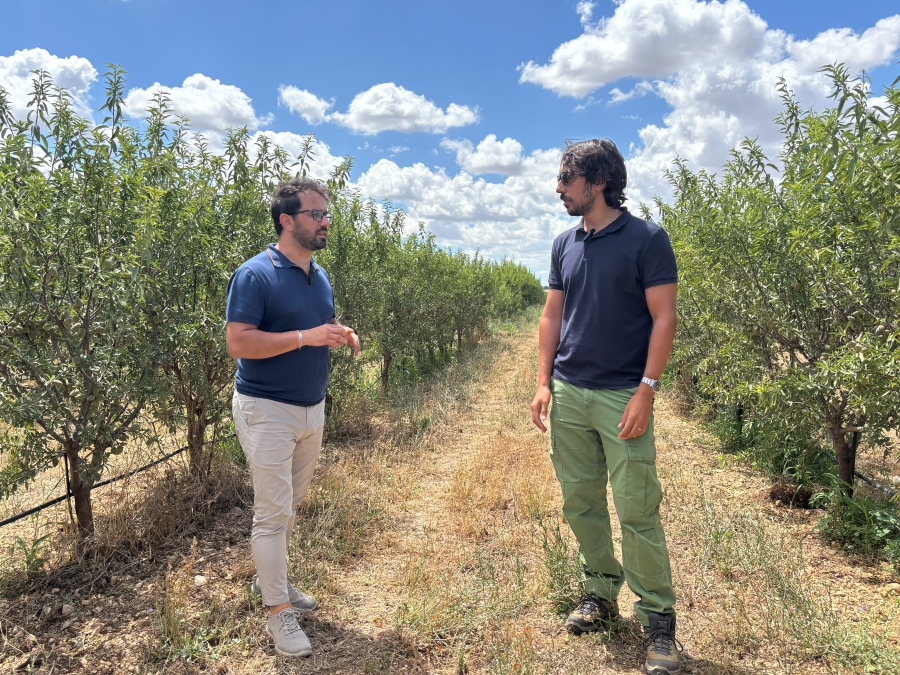
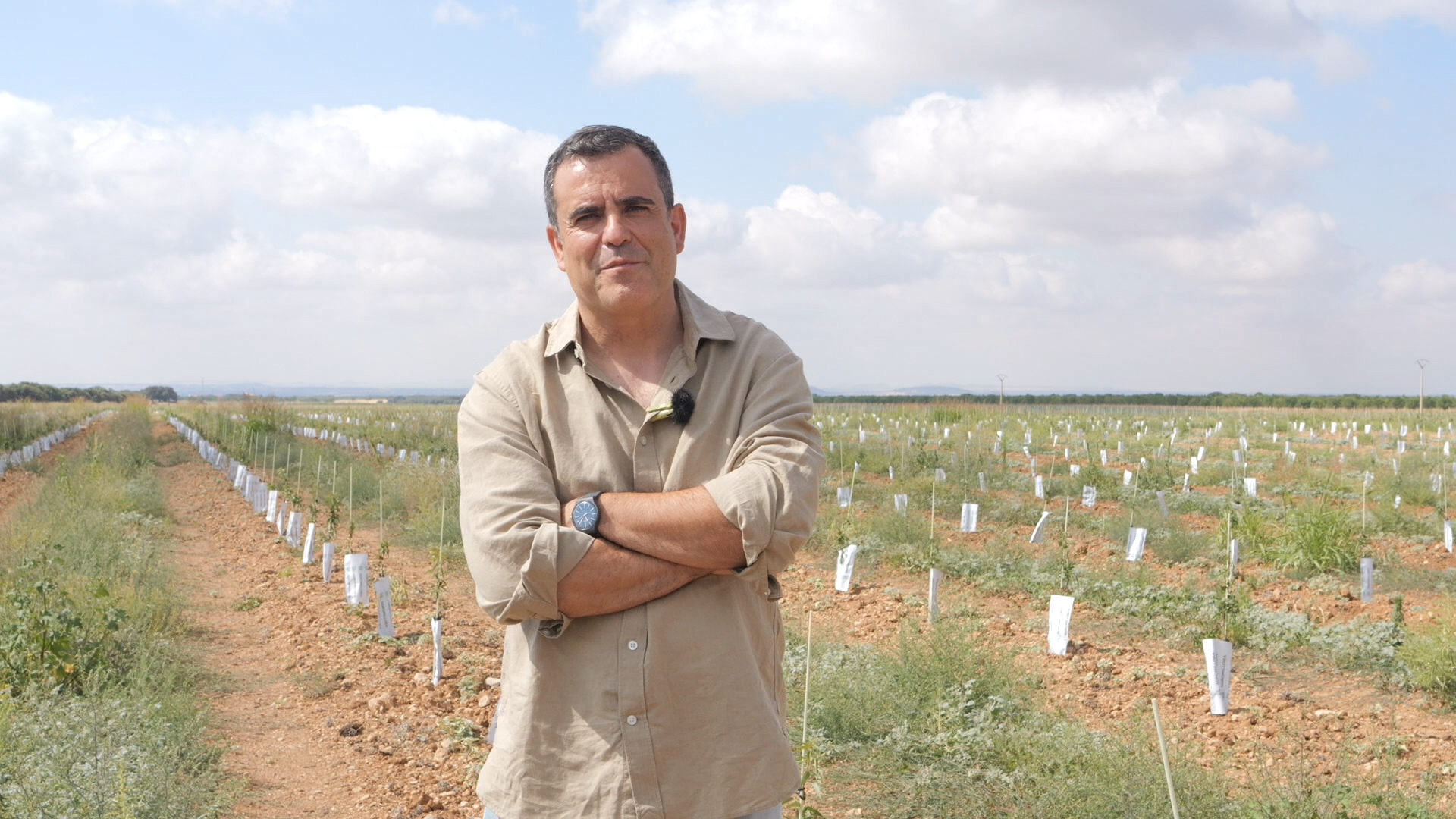
We spoke with Xavier Plana, the farm’s technical director, about how he turned it into a benchmark for hedgerow-style almond production
Planting Light Before Trees
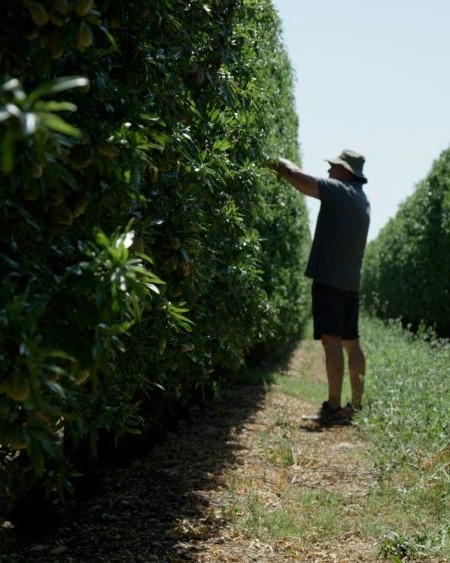
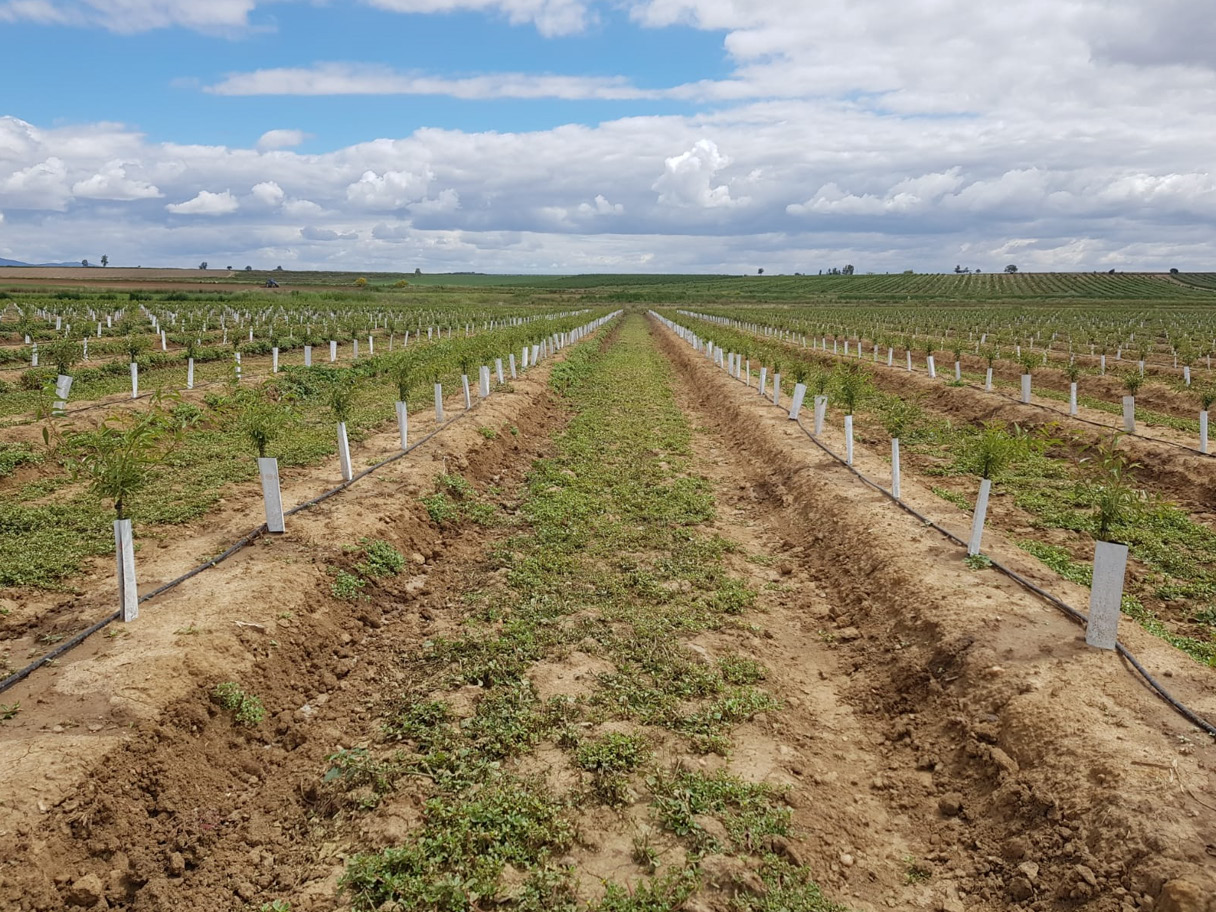
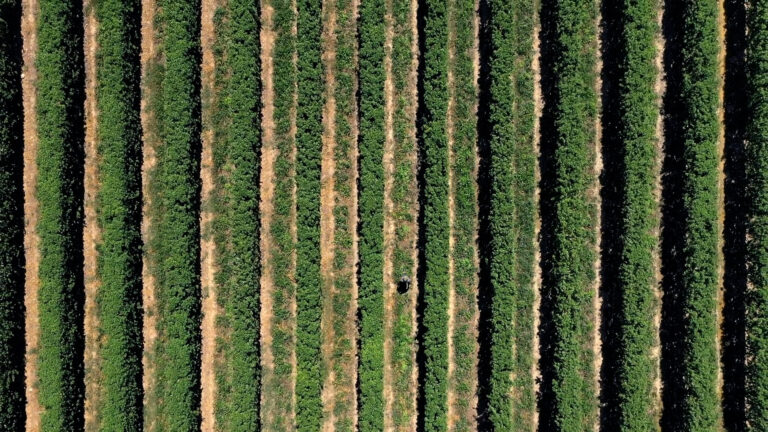
As soon as you leave the access road, the rows at Finca Montserrat reveal an almost architectural geometry: almond trees planted at 3.20 m x 1.20 m, trimmed with millimetric precision and aligned in narrow corridors. The scene, which today stands as a model of efficiency, was a counterintuitive gamble when Finca Montserrat began the project nine seasons ago. “Back then they recommended forming at seventy centimeters,” Plana recalls. “I insisted on forty to fifty. I knew that if the light entered the center early, the tree would close the gaps sooner.”
That principle—light as currency—guided the initial training. During the first three seasons, Plana combined 40 cm topping cuts depending on the varieties and their vigor, manual pruning to open the interior, and a generous yet measured irrigation-fertilizer program: “boost vigor without letting it run wild.” The result is the three‑meter‑tall vegetative wall that now leaves 0.5 m clean at the base and holds almost all the almonds on the outer surface. “If you fail in those first three years,” he insists, “you condemn the orchard forever. If you get it right, you have two decades ahead with very low labor needs.”
That “low” translates into four or five hours of work per hectare: one herbicide pass per year, checks on the drip emitters that wild boars stubbornly bite, and a maximum of ten phytosanitary treatments—four of them nonnegotiable. “After harvest I just shape a slight bevel, just enough to keep the hedge from invading the corridor,” he says while touching a cleanly angled cut. “The good almonds are on the outside; the interior wood, if it darkens, doesn’t bother me: it carries the structure and little more.”
Irrigation and Nutrition
Planted on Rootpac® 20, the almonds at Finca Montserrat require precision watering. Moisture probes show saw‑tooth curves ranging from 90% to 75% of field capacity: daily irrigations that, at the height of summer demand, deliver six millimeters split into two pulses of three millimeters every twelve hours. “A month before harvest we reduce one millimeter per week; last year we couldn’t because of the extreme heatwave that kept us between 35 and 39ºC from July 15 to August 15.”
“We tried giving all the water at once and the trees woke up wilted; in two pulses, the leaves stay alive through harvest.” In 2025, extreme temperatures pushed consumption up to 7,200 m³/ha; in other years, 6,000–6,500 are enough without visible yield loss. The goal, Plana repeats, “is to harvest with the canopy intact: green leaves mean kernel size and reserves.” Even surrounded by sensors and screens, he defends tree‑side judgment: “The probes inform, but the final decision belongs to the farmer. If shoot growth stalls, I stop; if it advances, I continue. I don’t want to delegate the farm to electronics.”
Nutrition has been fine‑tuned in the same way. The team started with 200 units of N/ha “out of fear of falling short”; evidence—excessive vegetative growth without added yield—reduced the dose to 90–110 units. “With 150 I don’t get more almonds, just more wood,” he says. Phosphorus stays at 35–40 units and potassium at 180–200 (“maybe a bit low, we’ll raise it”), while micronutrient inputs are limited to iron, manganese, and zinc. Monthly foliar analysis from May through July guides adjustments; later, he admits, “the almond is already made, and corrections are useless.” This year he added whole‑fruit nutrient analysis to better define potassium demand.
Harvesting Without Losing a Gram
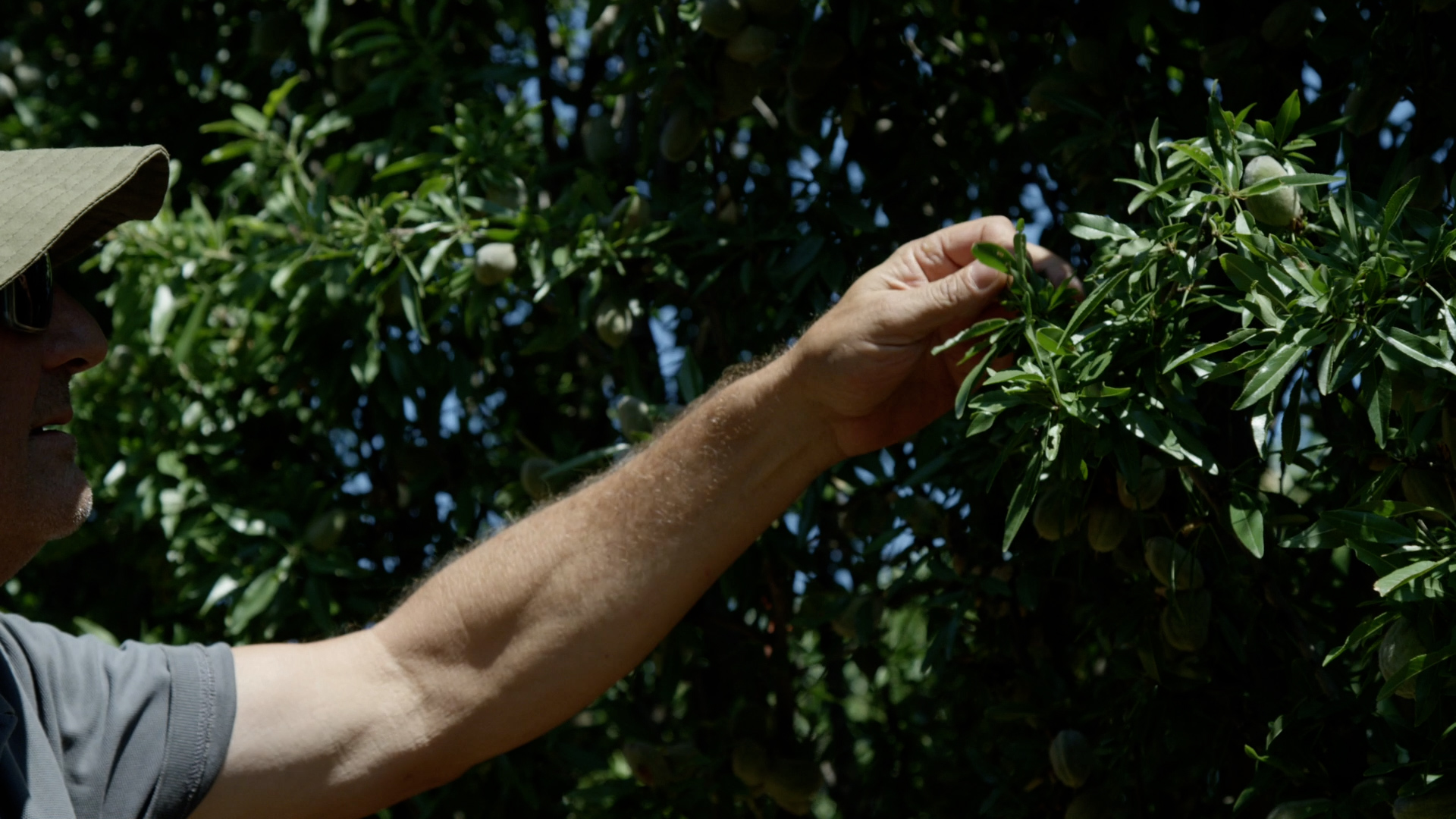
Between the 3,500 to 4,000 flowers a tree can produce and the roughly 1,000 final almonds, some 2,500 flowers naturally drop. Plana calculates that with just one thousand kernels per tree and a one‑gram average, yields would reach 2,600 kg/ha—and improving kernel percentage by just two points “changes the bottom line.” But as critical as fruit set is the integrity of the harvest.
Shellers demand almonds at 7–9% moisture; that dryness turns every gust of wind into a drop‑risk. “I prefer harvesting at 10–13%: the almond is greener and holds better,” he explains, pointing to the unusually clean ground. Machines, he acknowledges, are not perfect yet: “Farmers move faster than industry. We plant today and want technology to catch up tomorrow.” While waiting for harvest heads that reach 100% efficiency, he adjusts hedge formation to make their work easier: uniform height, smooth sides with no protrusions, and corridors allowing constant speed.
Labor stops being a problem in this system: nine full‑time workers plus temporary reinforcement handle 60 hectares in ten days of harvest. “There are fewer and fewer people for farm work, and those available are expensive. With this system I make a phone call and harvest is solved; conventional almond orchards with shakers drive costs way up.”
Reading the Climate Precisely
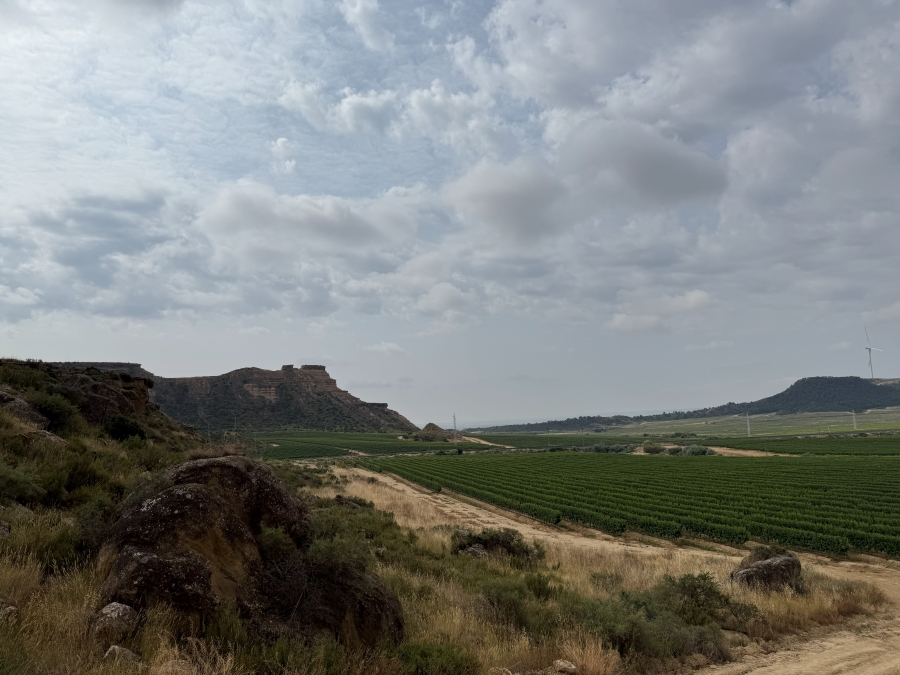
Rainfall in Lleida has dropped from 350 mm to 250 mm annually in just a decade, and frosts have become more erratic. Soleta, the farm’s early variety, can bloom in the first week of March; Lauranne follows around the fifteenth. Between those dates and mid‑April everything becomes a temperature roulette. “When the sensor shows half a degree above zero, the dance begins,” Plana confesses. “In bloom it holds; but once the jacket falls, half a degree below zero for one hour wipes out the crop. We’ve gone from zero to minus three in two hours.” Nighttime monitoring, anti‑stress irrigation, and hedge ventilation—which dissipates cold air—have so far prevented total losses.
The soil helps: a clay‑gravel mix with only 1–1.5% organic matter that drains four finger‑widths of water in an hour. “It’s gold for almonds: they hate wet feet,” the technician says while stirring the loose soil with his boot. “Here you can see puddles in the morning and dust in the afternoon.”
Listening to the Tree
When asked to summarize his lessons, Xavier Plana returns to the same verb: listen. The hedge, he says, is a finely tuned orchestra in which the plant sets the tempo and the farmer interprets. “Almonds come naturally if we’re punctual with light, water, and just the right amount of nutrients,” he says. “Sensors, drones, analytics… they all help, but the final word is spoken in the field. The tree tells you everything—if you know how to listen.”
That is the guiding thread of the logic of the hedge: a system that combines millimetrically trained vegetative walls, sip‑by‑sip irrigation, surgical nutrition, and lightning‑fast harvest with minimal labor. Thirty hectares of super‑intensive orchards may equal ninety hectares of traditional ones, Plana estimates; harvest heads may still need refinement, and potassium levels fine‑tuning.
But amid rising costs and shrinking labor availability, Finca Montserrat offers an eloquent fact: tons of almonds born at the wire, passing through the harvester, and reaching the factory with hardly any loss. A silent revolution that began by pruning against the grain—and that today illuminates, between perfectly aligned corridors, a bright future for Mediterranean almonds.