
“We want to reach 3,000 kilos of kernel per hectare”
Xavi Plana, technical director of the Montserrat estate (Raimat), signs off on a “very good campaign, with lots of kilos,” but sets his sights even higher for the next season
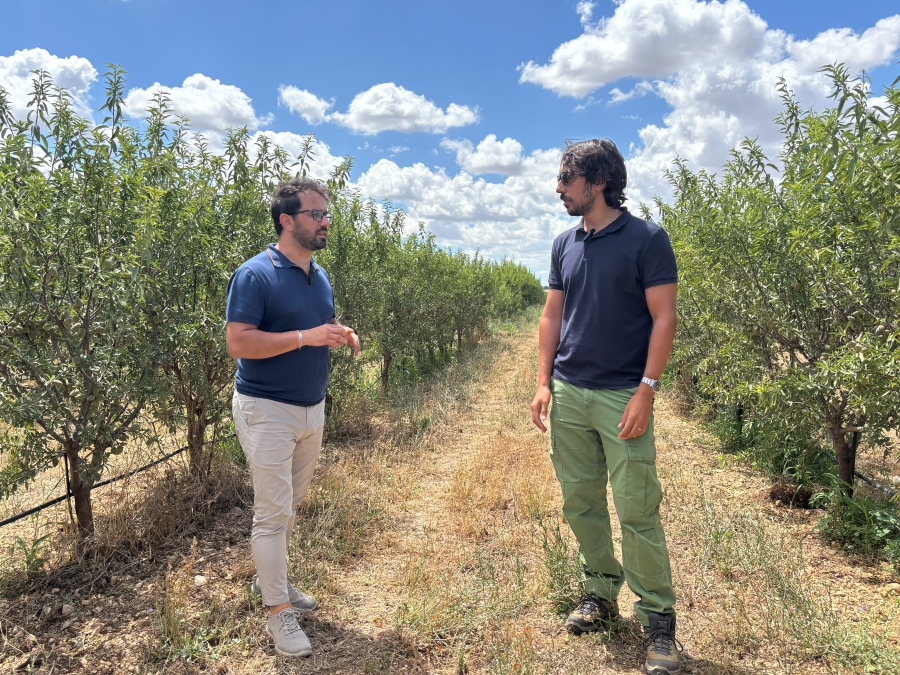
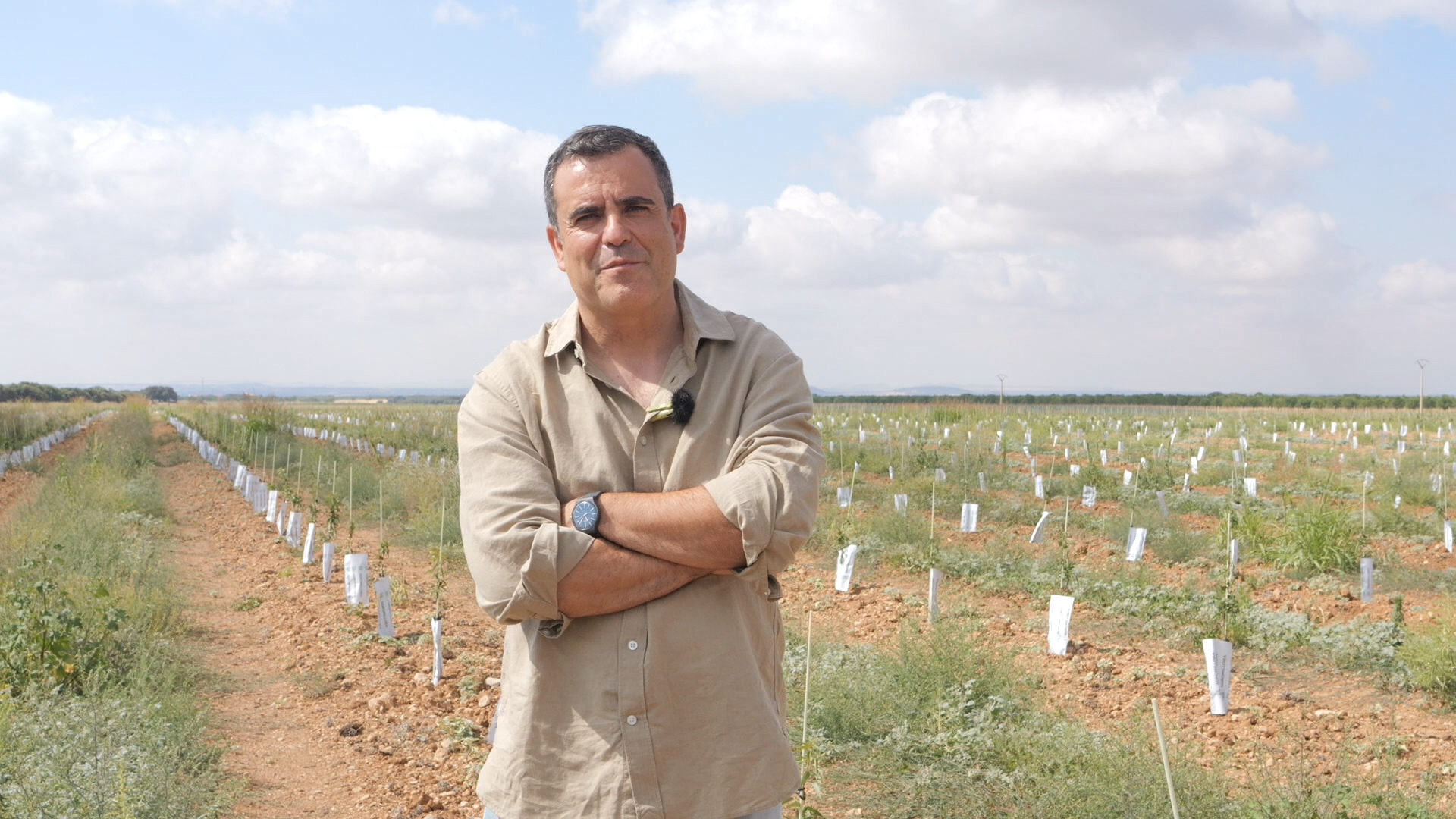
In Raimat, Xavi Plana, technical director of the Montserrat estate, speaks bluntly about the present and future of almond growing: “I can’t imagine an almond orchard that isn’t in a hedge system and can’t be harvested by machine.” He says this at the close of a campaign he describes as “very good, with lots of kilos,” in which the estate has consolidated management practices that, in his view, make the difference. Still, his ambitions go further: “Next year, thanks to the measures we’ve already started implementing, we aim to reach higher figures—we want to hit 3,000 kilos of kernel.”
Mechanization as the core of the system
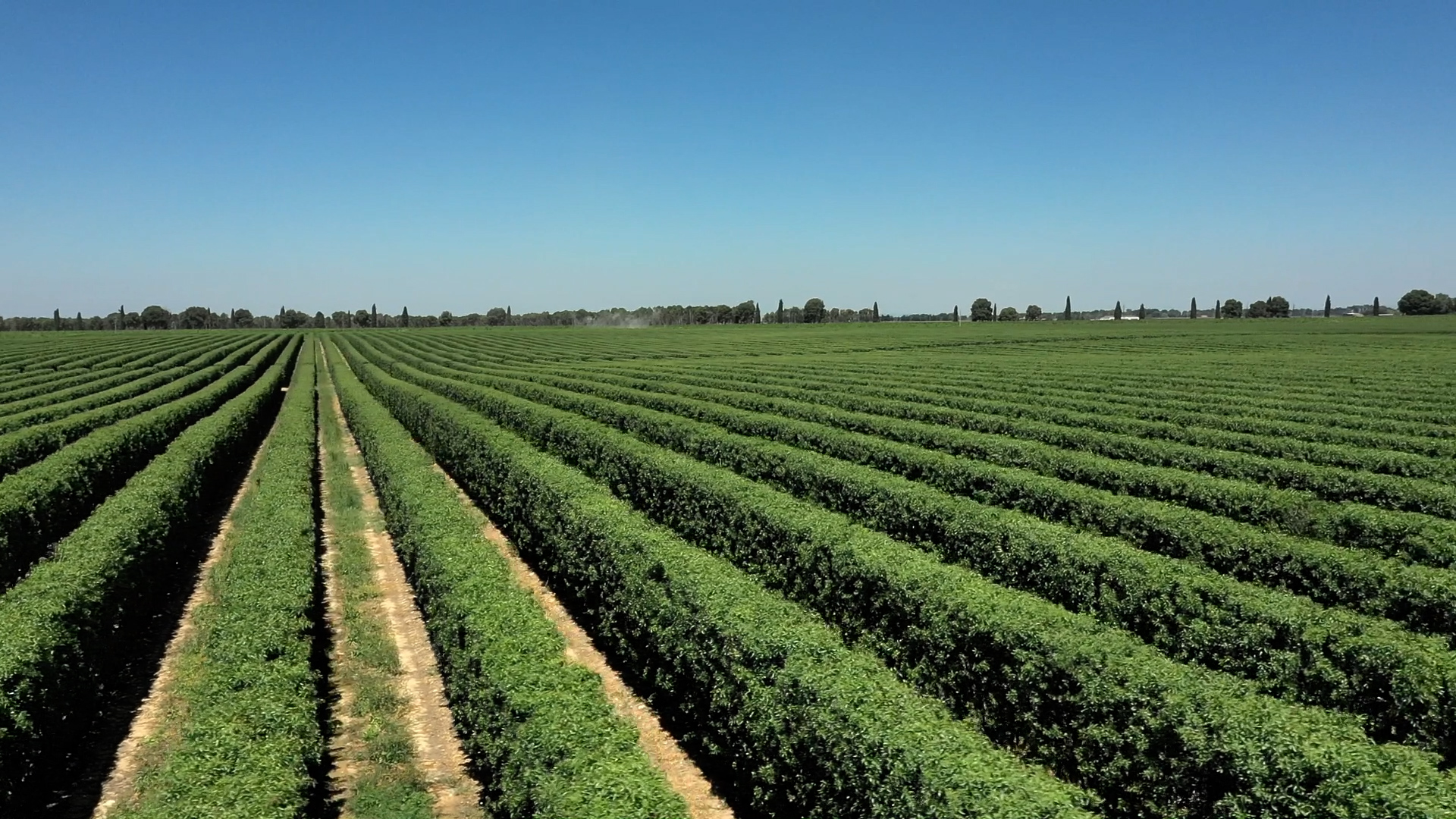
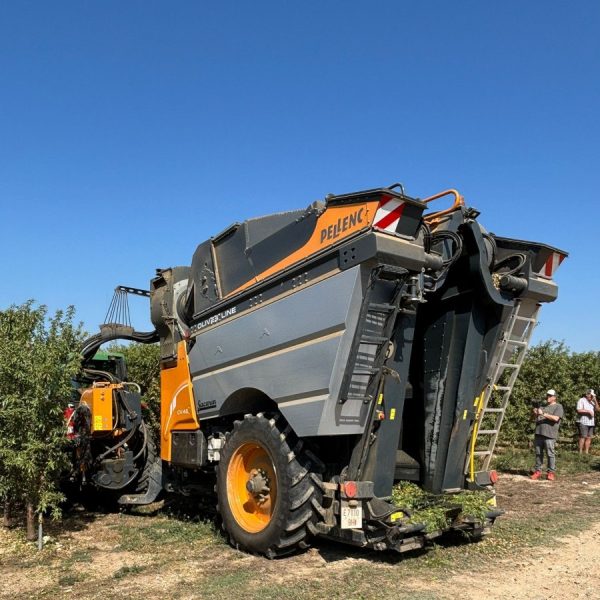
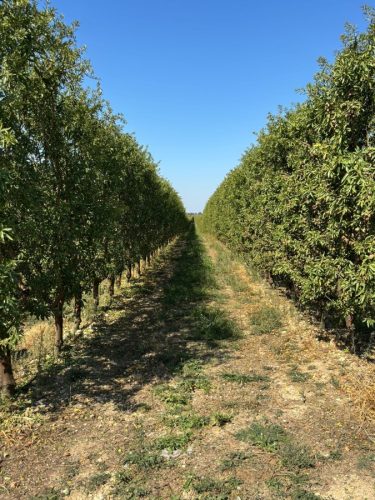
For Plana, mechanization is the cornerstone of everything. This season, they upgraded the hedge system from 2.70 m to 3.00 m with the arrival of the trailed Pellenc harvester: “It’s a machine that can harvest up to 3.20–3.30 m,” and at Montserrat they’re already considering going up to 3.20 m. “It’s very innovative; but 20 more centimeters, for me, means a lot of almonds—and that’s what will get us to the figures we want,” he argues. The planting frame (3.20 x 1.20) requires careful attention to light: “In the young orchard, the hedge has grown very narrow; light penetrates well, and at the top I need to shape it like a pyramid so as not to shade the lower parts.”
The economic argument backs his approach: “Last year the price was around €4.50 and this year €5.50; a production of 2,600 kilos at €5.50 brings you close to €12,000/ha,” he calculates. To that, he adds the cost differential between tree harvesting and ground harvesting: “From almond on the tree to ready for sale costs me €700/ha; for me that was €0.36 per kilo of kernel. Just the harvesting, about €550/ha,” he details. Speed and quality also matter: “Processors are starting to value almonds that haven’t touched the ground. On the ground they pick up dust and moisture; plus, you collect stones or sticks and the processing plant has to be much more sophisticated. With the over-the-row harvester, here, basically, it’s peel and done.”
Innovative techniques
Another key factor for this and future campaigns is pollination and fruit set: “We’ve been using bees for two years and I think they work very well,” Plana explains. They install five hives per hectare across the field and introduce them “when we find the first flower.” This year, everything aligned: “It was warm, there was no wind, and flowering was very short; in ten days Soleta had set, and during those ten days the bees worked very well.” The contrast with previous years is clear: “Soleta used to have spectacular flowering and the next year only four flowers remained; since we started doing this, we’ve achieved regularity in flowering.” The comparison with bumblebees, which they tried before, is also telling: “They work under harsher conditions, but there are very few in a box. Whereas in a bee hive there are 10,000 to 15,000 individuals… walking through the orchard was a festival.”
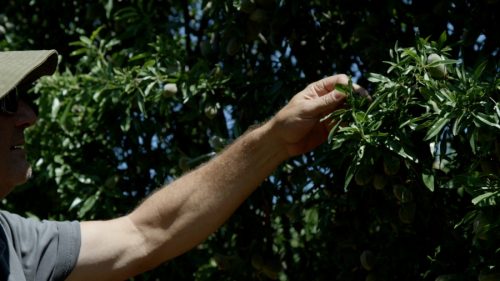
Innovation must be combined with meticulous agronomic management: “Hedge orchards aren’t difficult, but they’re not easy either,” he warns. For him, the first three years are “thorough”: you have to irrigate, fertilize, and train precisely within a short growth window “from late March until July 15; after July 15 the almond stops,” combining mechanical and manual tipping. This season, that was key: “We managed to raise boron to 120 ppm,” and maintained irrigation despite heat spikes in June and early August—something he says will be crucial when combined with taller hedges.
Agronomic management: precision and discipline
“The main thing is to do everything on time. If you tip when the branch is like a pencil, you cause a 20–25 day pause and lose growth. You can’t spend a month tipping; you have to try to do it in a week,” he insists. The goal of that training is to build “a vegetative wall as fully covered with branches as possible, without gaps”: “If it’s uniform and full of branches, you’ll have almonds for life.” And all with one guiding principle: “A narrow hedge so light can enter; if there’s light on the thick branches, there will be almonds.”
The ideal orientation is “north-south, north-south,” but at Montserrat it’s not perfect because the estate already had an anti-frost system installed and had to adapt to it: “For us, anti-frost is very important; I’ve never lost a crop to hail, but there have been two years when others did,” he recalls. Still, the technicians consulted reassured him: “They told me the orientation we have isn’t bad; light enters for about four or five hours a day and we shouldn’t have major problems.”
As for plant material, Plana shows a clear preference for one rootstock: “I really like ‘Rootpac 20’ for our soil; it’s delicate, not very vigorous, but if you know it—water and nutrients—it works. We have nine-year-old orchards and no double branches,” he describes. That wood flexibility fits his harvesting system: “With 20 mm branches, the machine gives a little tap and the almond falls right away; you don’t damage the tree or limit next year’s production.” By contrast, he’s seen very vigorous rootstocks that “after ten years have branches of 50 or 60 mm” and require “too strong a shake for the almond to fall.” Still, he’s open to “trying another rootstock” in the future: “You have to experiment. But it would be hard for me to change.”
“Ultimately, Plana champions a way of working that combines boldness and discipline: “This is for the brave,” he says about raising the hedge to 3.20 m when no one else has done it. But that boldness doesn’t excuse punctuality in tasks: “The work that needs to be done today gets done today.” That’s why he believes in super-intensive mechanization, well-planned pollination, and fast, precise hedge training. And that’s why he concludes without hesitation: “The future is in nuts, and almonds require practically zero labor—and that’s very important.”