
Marika Bianconcini: The Future of Hedgerow Almond Orchards in Emilia-Romagna
Interview with Marika Bianconcini on the introduction of hedgerow almonds in Emilia-Romagna and the work carried out by Romagna Impianti
Romagna Impianti’s work covers the entire lifecycle of orchard development, from design to field implementation. The company manages every operational phase, including installation of posts and trees, planting (both mechanical and manual), and full orchard management over time. This also includes key aspects such as nutrition and plant protection, contributing to a more sustainable and efficient system for farms.
As Marika Bianconcini explains, “today it is essential to offer a complete service that supports farmers through every stage, from design to orchard management.”
In recent years, it has become increasingly evident that climate conditions significantly affect plant behavior. Mild winters tend to accelerate plant physiology, leading to earlier flowering, while colder seasons delay the cycle and shift the phenological window forward. “We’ve clearly seen that warm winters bring flowering forward, while colder ones can delay it by several weeks,” Bianconcini notes.
The introduction of hedgerow almonds in Emilia-Romagna dates back to 2020–2021, when the project was launched following several technical evaluations. The decision was mainly driven by the high level of mechanization this system allows: from planting to production, most operations can be carried out using machinery, significantly reducing labor requirements.
“Mechanization has been the key driver. It allows us to work more efficiently and rely less on labor, which is becoming increasingly difficult to find,” she says.
In the early stages, orchards were established using mechanical planting techniques, similar to those used for other tree crops. Later, an irrigation support system was introduced—initially elevated and later moved to ground level. Among the main advantages observed is increased productivity compared to traditional almond systems, which has encouraged its adoption in a region where almonds were not historically grown.
Mechanization also plays a critical role economically, enabling higher profitability than traditional systems, which require significant labor for pruning, harvesting, and other operations.

One of the biggest challenges has been the design phase. Adapting planting systems and choosing between potted plants or bare-root trees requires a detailed analysis of each farm’s conditions. Field assessments—such as soil characteristics, row orientation, and climate—are essential “Every orchard is different. Without careful preliminary analysis, it’s not possible to achieve optimal results,” Bianconcini emphasizes.
The company’s expertise extends beyond almonds to both fruit and vine crops, with strong experience in high-density, two-dimensional systems.
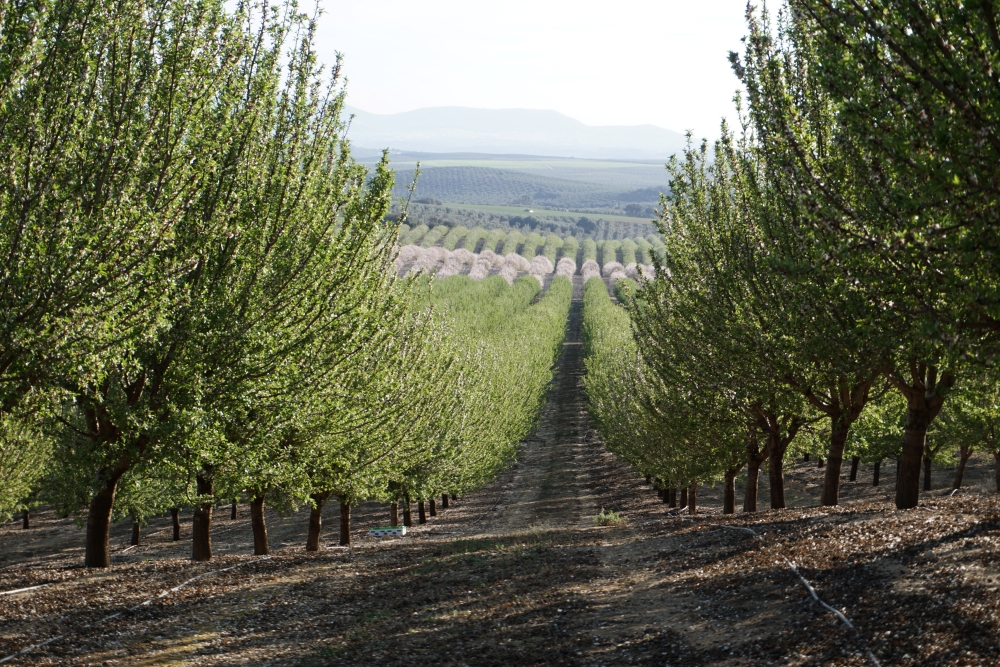
Compared to traditional open-vase systems, hedgerow orchards offer several advantages. In addition to reducing labor needs, they allow better control of agronomic practices. Crop protection treatments are more precise and efficient, reducing environmental impact.
Regarding varieties, the orchard has also been designed as a trial field. Late-flowering varieties such as Makako, Penta, and Vialfas have been planted, along with other test cultivars, to evaluate their performance under local conditions.
“We wanted to create a demonstration field where growers can directly observe varietal differences and select the most suitable options,” she explains.
From a phenological standpoint, flowering typically follows a sequence: Avijor in late March, followed by Penta and Makako, and finally Vialfas in early April. However, these timelines are highly influenced by weather conditions, especially given that frost events can now occur throughout April.
Finally, the introduction of mechanical pruning has also represented a cultural shift.
“At first it wasn’t easy—there’s a strong tradition of manual pruning. But once the benefits became clear, adoption gradually followed,” Bianconcini concludes.