


Ilitia, Brunella and Florentia are born: new pieces for the varietal revolution in olive growing
Through the breeding program of the University of Florence, Ilitia, Brunella and Florentia are introduced to join the range of new hedge olive varieties that will shape the future of modern olive cultivation.
With agronomic characteristics that address today’s challenges—such as cold tolerance, early bearing and high oil quality—these varieties are set to become key components of the hedge olive system.
Experience over recent years has shown that the success of hedge systems depends not only on plantation design or mechanization levels, but largely on plant material. Dependence on a limited number of varieties has highlighted the need to broaden the varietal range. Genetic improvement thus becomes a strategic tool to ensure the sustainability of the system.
It is in this context that Ilitia, Brunella and Florentia are born—three new varieties specifically developed to meet the demands of hedge olive growing and to complement the existing varietal catalogue. The goal is not to find a single ideal variety, but to offer differentiated solutions for diverse grower profiles and cultivation conditions.
As Edgardo Giordani, head of the breeding program at the University of Florence, has stated: “The ideotype of the past, mainly focused on cold resistance, now requires consideration of aspects such as productivity, ease of agronomic management through mechanization […] without losing sight of the need to improve the organoleptic qualities of the oil.” This reflection summarizes the paradigm shift taking place in modern olive growing.
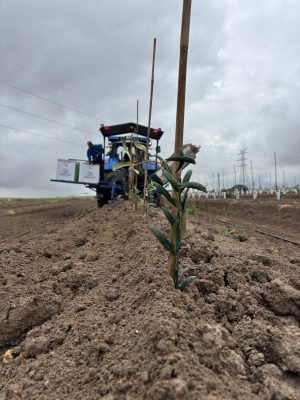
Three new varieties, three new agronomic answers
Ilitia is clearly focused on productive efficiency and mechanization. It enters production earlier than Arbosana, with less wood, more fruit and greater efficiency from the outset. It is a modern, early-bearing and uniform variety, with controlled vigor and a structure that favors hedge uniformity. Field data confirm not only high productivity but also production stability, without alternate bearing, enabling greater yield predictability and faster return on initial investment.
Vigor comparisons conducted across different farms show that Ilitia presents balanced growth compared to benchmark varieties, facilitating its integration into hedge plantations. These characteristics make Ilitia especially suitable for professional farms focused on production, profitability and operational efficiency.
Florentia, on the other hand, is oriented toward growers who prioritize oil sensory quality and production stability. It is characterized by early bearing, early ripening and an upright growth habit, with medium vigor that facilitates hedge management. Monitoring in different orchards shows medium-to-high and regular productivity, with no tendency toward alternate bearing—an essential factor for economic planning.
One of Florentia’s most notable traits is its performance under limited water availability, maintaining balanced production and good stability year after year. This makes it particularly suitable for rainfed conditions or for growers aiming to optimize water use. Although oil yield is not its main attribute, its intense aromatic profile makes it attractive for quality-driven differentiation strategies.
Brunella completes this varietal trio with a very distinct agronomic profile. It stands out for its very low vigor and upright growth habit, characteristics that significantly simplify hedge management and reduce the need for vegetative interventions.
From an oil perspective, Brunella offers a mild and aromatic profile aligned with current market demands. To fully express its potential, it requires fertile soils and adequate water availability, conditions under which it delivers highly competitive results.

More options for a more resilient olive grove
The incorporation of Ilitia, Brunella and Florentia into the hedge olive varietal catalogue responds to a structural need in the sector: diversifying to reduce risks and increase the resilience of the production system.
In a constantly changing environment, expanding the varietal range is not only a competitive advantage but also a guarantee for the future of olive growing. The new varieties from the University of Florence represent another step toward a more flexible, resilient olive sector prepared to face future challenges.


