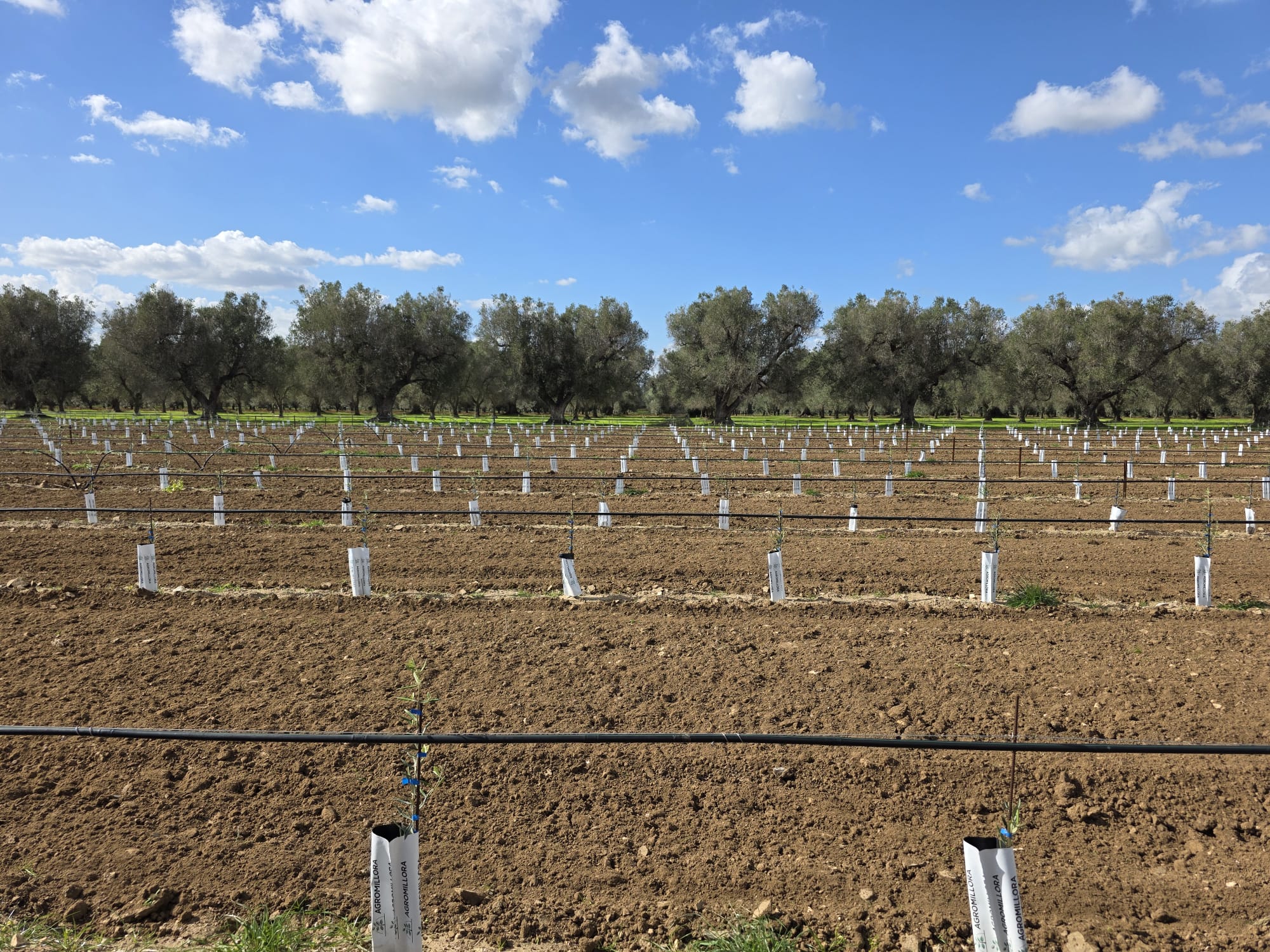

Lecciana in Alto Aragón: Adaptability and Efficiency for Dryland Farming
We spoke with Lorenzo Urroz, Administrator and General Manager of Molino de Olivas de Bolea, about the performance of Lecciana under dry-farming conditions in Alto Aragón.
To begin with, what led you to introduce Lecciana in your groves in Alto Aragón? What were you looking for when selecting a new variety like this?
Nearly two decades ago, we began planting in hedgerow systems, aiming from the outset to adapt to the specific conditions of our area, where dryland farming and the lack of irrigation impose certain limitations. Over this time, we’ve explored varieties that could work well with this intensive hedgerow system while still delivering good results under rainfed conditions.
In this context, in 2020, at the height of the pandemic, we decided to conduct a comparative trial between Arbequina— a variety we know well and that has traditionally been grown on our farms— and Lecciana, which was starting to gain interest. We were looking for a variety well adapted to the climate, tolerant to water stress, with stable productivity and, if possible, a distinctive organoleptic profile. Lecciana appeared to meet many of these criteria, which led us to include it in a trial.
You work in an area with harsh winters and risk of frost. How has Lecciana performed under these demanding climatic conditions?
Indeed, winters are no longer like they were 20 years ago, but we still experience severe frosts every year for at least two weeks. This past winter was especially representative, with temperatures dropping to between -7 and -9 °C (19 to 16 °F) for at least a week.
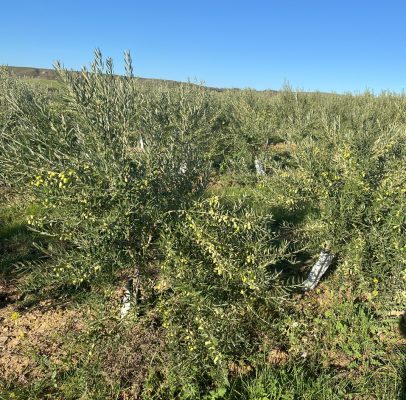
We observed with great interest that Lecciana showed remarkable resistance: we saw virtually no defoliation, which contrasted sharply with Arbequina, which suffered significant leaf loss. This difference is highly relevant in our conditions, as defoliation affects both bud break and the tree’s recovery in spring. This good initial response to low temperatures encourages us to continue monitoring its behavior in the coming years.
What differences have you noticed compared to other traditional varieties in terms of cold resistance and recovery after frost events?
The main difference is precisely that: its ability to maintain foliage intact after periods of intense cold. In our direct comparison, Arbequina experienced significant leaf drop, which can compromise subsequent vegetative activity. In contrast, Lecciana has shown notable resistance, with hardly any visible symptoms of cold damage.
Although it is still early to draw long-term conclusions, this initial performance reinforces its potential as a variety adapted to regions with harsh winters and frost risk.
Have you observed good sprouting and flowering after particularly cold winters? How has it performed when coming out of winter dormancy?
So far, we have only completed one harvest, in 2024, so we do not yet have a long enough dataset to establish firm patterns. However, in 2025, flowering was especially striking: it exceeded our expectations both in flower quantity and uniformity.
This is encouraging, as it suggests that the variety not only tolerates cold well but also starts strongly in spring. In terms of vegetative growth, Lecciana stands out for its vigor: each season it surprises us with its ability to produce new wood, which can be very interesting from a productive standpoint, although it also poses management challenges.
From an agronomic perspective, what would you highlight about Lecciana in terms of vigor, tree structure, and ease of field management?
Agronomically, Lecciana is a vigorous variety that achieves notable development with very little nutritional input. This is an advantage in dryland conditions, but it requires careful management.
Regarding tree structure, we are working, for the first time, with the Smart Tree system, which involves a learning curve. Lecciana produces very abundant branching and particularly flexible shoots, which, during fruit load, give the tree a “weeping” habit.
This has required structural intervention, raising the canopy formation to ensure that the harvesting machine can operate efficiently.
In olive oils, Lecciana is presented as a balanced variety with high polyphenol content. What oil yield are you obtaining, and how do you assess its production stability?
Although we are still in a discovery phase, the term “balance” accurately defines our first impressions of Lecciana. We have observed oil yields approximately 3 percentage points higher than Arbequina, which represents a very significant improvement under our dryland conditions.
As for production stability, we still do not have enough seasons to assess regularity, but so far the trend is positive. In addition, the higher polyphenol content not only contributes to greater oil stability but also provides a more complex sensory profile, something we value highly in our approach to differentiation.

At Molino de Olivas de Bolea, you focus on differentiated quality oils. What has Lecciana contributed in terms of sensory profile? How does it fit into your current range?
Lecciana represents an ideal complement to our oil range. In northern Spain, consumers tend to prefer milder, “sweeter” oils, so our traditional offering fits well.
However, Lecciana allows us to introduce a complementary proposal with a different organoleptic profile, without being excessively bitter or pungent. It is a variety that balances character with elegance very well, offering green, fresh notes and a persistence on the palate that makes it stand out.

Based on your experience, do you see Lecciana as a particularly interesting variety for cold areas or regions with late frost risk?
Our experience is still limited in time, so it would be premature to make a definitive statement. However, initial results have been promising: its good cold tolerance, minimal defoliation, and vigorous spring recovery are all positive indicators.
We believe it could be a very interesting alternative for hedgerow plantings in dryland areas. Additionally, its cold resistance is a clear advantage.
For other growers working under similar conditions, what advice would you give if they are considering introducing Lecciana?
Giving advice in agriculture is always delicate, as each farm has its own specific conditions: soil, climate, management practices, etc.
However, what we can say is that today, introducing Lecciana involves much less risk than it did a few years ago. There are now numerous experiences across different regions, both irrigated and rainfed, and we increasingly have more references.
For those working in hedgerow systems and looking for a variety with higher oil yield, good cold adaptation, and a balanced oil profile, it can be very interesting. We encourage anyone at that stage to conduct trials on their own farms—seeing its behavior in situ is the best way to assess its true potential.