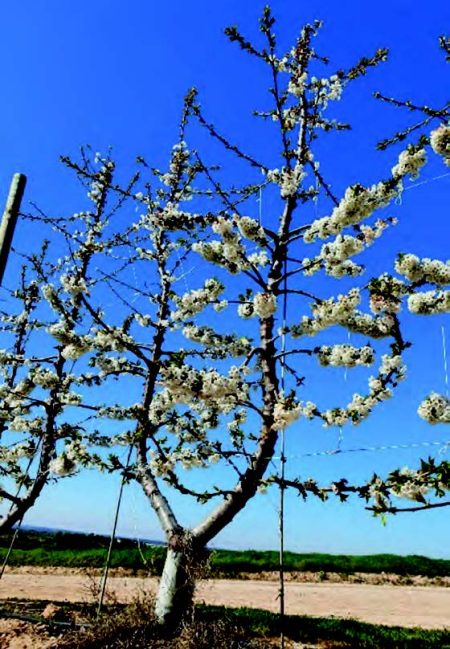

The Corette® Rootstock Series Opens New Opportunities for Cherry Cultivation in Spain
Ignasi Iglesias, Technical Director of Agromillora, explains the adaptability of the Corette® rootstock series to Mediterranean soils and its potential for more efficient, profitable, and sustainable intensive orchards.
Cherry production has become one of the highest value-added fruit crops in Spain, although it is also one of the most technically, agronomically, and commercially demanding. With a current area of nearly 29,000 hectares and an average annual production of 121,000 tons, Spain is the leading exporter in the European Union. Among all fruits, cherries are the only one showing an upward consumption trend since 1989.
In a context shaped by climate change and increasing demands from markets and retail distribution, the sector faces the constant challenge of evolving in order to maintain productivity, fruit quality, and farm profitability, with innovation as the guiding axis for the future of the crop.
According to Ignasi Iglesias, PhD in Agricultural Engineering and Technical Director of Agromillora, innovation in cherry cultivation is based on three fundamental pillars: varieties, rootstocks, and training systems, all of which must lead to optimal, high-quality production. “In varieties there is a great deal of innovation, with mid-chilling and low-chilling materials, as well as new later-ripening selections that allow the harvest calendar to be extended, even more so when grown at higher altitudes. Regarding rootstocks, the goal is to achieve the desired vigor, compatibility with varieties, adaptability to soil conditions, resistance to diseases, and tolerance to the effects of climate change—especially high summer temperatures and reduced winter chilling—while also inducing good productivity. And when we talk about training systems, we are referring to the vigor conferred on the variety, planting density, and tree architecture.”
In this regard, the Technical Director of Agromillora points out that “across all fruit species there is a clear trend toward intensification, with smaller tree volumes and flat or 2D wall systems such as single axis, bi-axis, or tri-axis, in order to improve labor efficiency in pruning, thinning, and harvesting, facilitate mechanization, and reduce production costs—especially harvesting labor, which accounts for 60% of total production costs.” Iglesias emphasizes that these three elements define the technical evolution of the crop. “That is where cherry innovation lies, because there is really no alternative pathway: which variety you plant, which rootstock you use, and, based on that combination, what tree shape you design to maximize accessibility for people and machines. Each of these aspects is constantly evolving and drives innovation in this crop,” along with advances in digitalization, soil–plant–climate monitoring, and robotics
The Corette® Series Gains Prominence
In the field of rootstocks, the Technical Director of Agromillora acknowledges that innovation to date has been “rather limited, especially considering our specific edaphoclimatic conditions: generally calcareous soils and high summer temperatures,” but he notes that “new developments are starting to emerge.” Among these, he highlights the use of well-established series in international markets. For example, one widely used in northern Europe, northern Italy, or Chile is the GiSelA® series, specifically GiSelA®5 and GiSelA®6. Both were developed in Giessen (Germany) and licensed to CDB. These rootstocks reduce tree vigor, allow orchard intensification, enable very early bearing, achieve high yields with good fruit size, and allow mechanization of operations such as pruning, thinning, or harvesting (Iglesias et al., 2024). “This option has been available on the market for many years.” However, Iglesias clarifies that “these rootstocks are not well adapted in Spain to Mediterranean areas with warm climates, calcareous soils, and basic pH, which are very different from the conditions in northern Italy, Chile, northern Europe, or Germany, where they originated.”
Faced with the limitations of GiSelA® rootstocks in Spain, Agromillora sought a different genetic background: the Corette® series. This is a group of five rootstocks—Cass, Clare, Clinton, Crawford, and Lake—developed by Michigan State University (MSU) in the United States from species found in biodiversity centers in Europe and Russia. Their genetic origin is shown in Table 1. They confer low vigor, well below SL-64 and Adara (reference rootstocks in Spain), and also lower than GiSelA®6. The series is relatively recent, although not new, as it was obtained and selected between 2000 and 2010. “An experimental license allowed Agromillora to introduce and propagate them in order to establish experimental plantings between 2022 and 2025, alongside other CDB rootstocks from the GiSelA® series,” Iglesias explains.

“The experimental network, coordinated by Agromillora and CDB, aims to evaluate the adaptability of different rootstocks to the edaphoclimatic conditions of Spain and other European countries. Two levels of experimentation have been established: the first began in 2023 in three Spanish locations (Mequinenza–Zaragoza, Albalate de Cinca–Huesca, and Cabrero–Jerte Valley, Cáceres), and in two Italian locations (Vignola and Sammichele–Bari) in 2025, in collaboration with industry companies and research institutes. The second level began in 2025 within the EUFRIN (European Fruit Research Network), involving research centers in 18 countries, with different varieties depending on the area,” explains the Technical Director of Agromillora.
“The three trials in Spain are now, in 2026, in their fourth year after planting and have shown interesting results up to 2025—specifically, good adaptation of some rootstocks such as Clare or Crawford to warm Mediterranean climates, adequate vigor and growth (except for Clinton), early bearing, and yields that in some combinations with the Sweet Aryana® variety exceeded 11 t/ha in 2025 (third leaf), something that was not observed with GiSelA®5 and GiSelA®6,” adds Iglesias.
Although it is still early to deliver a definitive verdict on whether this rootstock series is ideally suited to Spain and other European countries, the Technical Director of Agromillora explains that they continue “to monitor performance until the trees reach maturity and we have well-validated, multi-location references, both in calcareous soils and warm Mediterranean climates, and in acidic soils and temperate climates such as Extremadura or central and northern Europe, in order to understand their true adaptability.”
Regarding future development, Iglesias notes that if results remain positive, the next step will be “to initiate commercial-scale development in different countries around the world, as there is considerable interest from companies in this type of plant material for the establishment of intensive orchards.” As he adds, “intensification ultimately means planting more trees per hectare, but it also means producing faster, with better fruit quality and lower production costs over the life of the orchard.”
Training and Orchard Systems
The final dimension of innovation in cherry production—training and orchard systems—is also a key factor in optimizing production, mechanization, and harvesting efficiency.
“The shape or architecture of the tree is critical because it directly affects harvesting efficiency. For example, flat trees allow easier access to fruit, whereas taller trees require ladders—a practice that is already banned in certain countries,” Iglesias explains. He highlights flat or 2D systems, noting that “recent studies published in Washington (Wittig, 2022) show that harvest efficiency increased by 72% in a UFO (multi-axis, 2D) system compared with traditional vase-shaped trees.” He adds that “the 2D system enables pedestrian or semi-pedestrian harvesting using small ladders and allows mechanical pruning and bud or flower thinning using equipment such as the ‘Darwin’.”
Today, flat systems are the most widely used training forms in apple and pear worldwide and are increasingly being adopted in intensive cherry orchards, as they allow faster and more efficient harvesting. In addition, these systems offer a clear advantage for future technological developments such as canopy scanning for flower or fruit counting, yield forecasting, and the roboticization of pruning, flower or fruit thinning, and harvesting.
Overall, innovation in cherry cultivation in Spain is advancing along three complementary pillars: the selection of well-adapted varieties, the development of rootstocks such as Corette® or new GiSelA® types adapted to Mediterranean climates and soils, and intensive training systems—particularly bidimensional systems—to maximize yield, fruit quality, harvesting efficiency, and mechanization. In addition, both rootstocks and varieties in southern Europe will need to be increasingly adapted to declining winter chill availability linked to climate change (Guerrero et al., 2024).